Roofing
Roof restoration vs re-roofing: what restoration actually covers
By the Peak Surfaces team · · 6 min read
Roof restoration cleans, repairs and recoats the roof you already have; re-roofing strips the covering off and installs a new one. Restoration suits a structurally sound concrete tile, terracotta or metal roof that looks tired, while re-roofing is for a roof whose tiles or sheets have reached the end of their life, and the two are different trades. Knowing which side of that line your roof sits on saves you from paying for a coating a roof cannot hold, or replacing a roof that had years left in it.
Peak Surfaces restores roofs across Melbourne and Victoria from our base in Coolaroo, and we do not re-roof, so the only question our quote answers is whether restoration will work on your roof. If it will not, we say so.
What a roof restoration includes
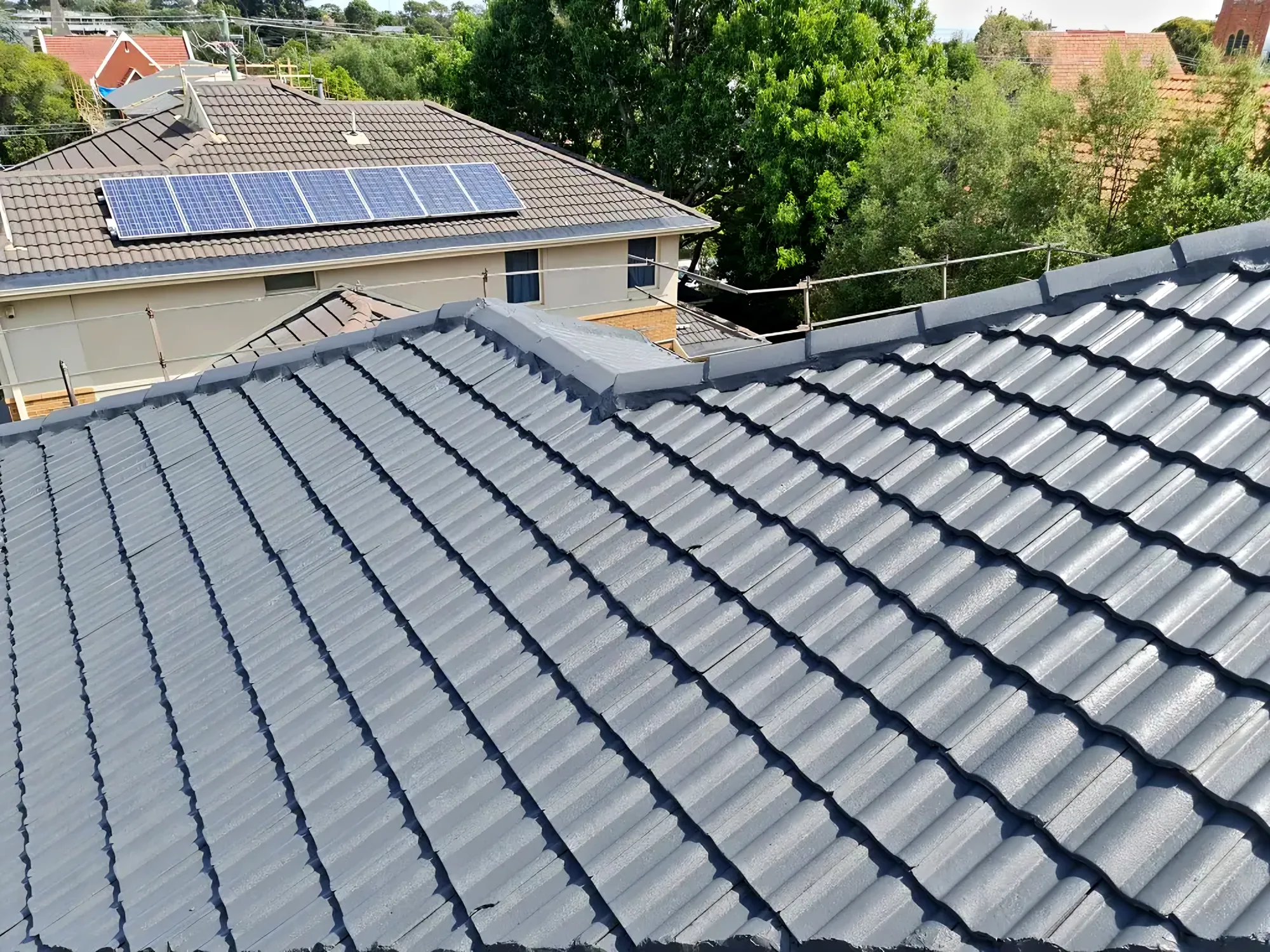
A full restoration has four stages: a high-pressure clean, a moss and lichen treatment, ridge cap rebedding and repointing, and a membrane coating. The clean strips dirt, chalky residue, moss and lichen off from the ridge down so the sludge runs out through the gutters. The treatment then kills the spores the wash cannot reach, so growth does not return under the new coating.
Ridge and hip caps sit on a bed of mortar that cracks and crumbles after decades of expansion and contraction. Rebedding sets the loose caps on fresh mortar; repointing then seals the joint between cap and tile with flexible pointing compound that moves with the roof instead of cracking. The coating goes on last: a primer or sealer suited to the surface, then reflective roof membrane in two coats of the chosen colour.
- High-pressure wash from ridge to gutter, with the gutters flushed afterwards
- Moss and lichen treatment applied once the roof is clean
- Loose ridge and hip caps rebedded on fresh mortar
- Every cap repointed with flexible pointing compound
- Primer or sealer, then reflective roof membrane in two coats
Which roofs suit restoration
Restoration suits a roof that is structurally sound and still keeps the water out but has lost its surface: concrete tiles that have faded and gone chalky, glazed terracotta carrying moss and crumbling ridge mortar, or a metal roof whose colour chalks onto your hand. The frame underneath must be straight and the tiles or sheets themselves still solid.
Each material gets a slightly different treatment. Concrete tiles take the full clean, treat, rebed, repoint and coat sequence, because the membrane replaces the surface the tile has lost. Glazed terracotta is typically cleaned, treated and repointed but not coated, since the glaze is the finish and a coating will not bond to it reliably. Metal is cleaned, treated for surface rust, primed and coated.
- Concrete tile: faded, chalky or patchy colour, but tiles solid and mostly uncracked
- Terracotta: moss, lichen and failed ridge mortar on tiles with their glaze intact
- Metal: dulled or chalking colour and surface rust, with no holes or rusted-through sheets
- Any roof where leaks trace to ridge mortar, blocked valleys or gutters rather than the tiles themselves
Signs a roof is past restoration
A roof is past restoration when the covering itself is failing rather than just its surface. Concrete tiles that have gone porous soak up water and crumble at the edges; you can often snap a corner off by hand, and no coating restores strength to a tile that is breaking down. Terracotta that has lost its glaze and started fretting, with the face flaking off in layers, is in the same position.
On a metal roof, rust that has eaten through the sheet, or corrosion along the laps and around every fastener, means the sheet has to go. Under any roof, a sagging ridge line, bowed battens or a soft ceiling below the roof space are structural problems that cleaning and coating cannot touch.
- Tiles that crumble, flake or snap under light hand pressure
- A large share of tiles cracked or broken, not just a handful
- Metal rusted through, or holed around fasteners and overlaps
- A sagging or wavy ridge line that points to the frame underneath
- Leaks spread across the roof surface rather than at a ridge, valley or gutter
Re-roofing is a different trade
Re-roofing means removing the existing tiles or sheets, repairing or replacing battens and sarking, and fitting a new roof covering, and it is a separate trade from restoration. A roof tiler or roof plumber carries it out, usually with scaffolding, bins and a longer program, and the result is a new roof rather than a renewed one. Peak Surfaces does not provide re-roofing, roof replacement or new roof installation.
What we will do is tell you plainly which side of the line your roof is on. A proper assessment means walking the roof, tapping tiles, lifting a ridge cap and looking in the roof space, not pricing a coating from the footpath. If the roof is not sound, a coating would only hide the problem until the next heavy rain, and we would rather say so than sell you one.
Gutters, downpipes and the rest of the system
Many leaks blamed on the roof start in the gutters, and a restoration is the natural time to deal with them. Blocked gutters back water up under the bottom row of tiles, rusted joints drip onto the fascia, and a downpipe that has pulled away from its outlet dumps water against the wall. Clearing, patching and resealing these is maintenance, not re-roofing, and the same team handles it.
- Debris cleared and downpipes checked for blockages
- Leaking joints patched and resealed
- Gutter guards fitted where leaf fall keeps blocking the run